The Whisper of the Nymphs (the small contains a universe)
During my walks through the forest, I found a
place:
42°5'29.76" N 12°53'4.56" E,
a tiny spot measuring less than 50 m². Here, sunlight timidly filters through the trees for just a few hours each day. The Fosso Maricella stream is barely a trickle of water, whose hypnotic sound accompanies the stillness of the place. In this small corner, scale takes on a new meaning: the small contains a universe, and time seems to follow a different rhythm.
“Doesn’t anyone notice? Doesn’t anyone complain?” I’m often asked these questions when people see my photos of passengers. I understand them, to some extent. Even though the spaces where we photograph are public, the moments are intimate. In the madness of urban overcrowding, we seek intimacy in the anonymity of the crowd. Observing that space seems unsettling to those who consider it private. It is assumed that other passengers are not interested in their companions either, that everyone shares the unspoken rule of non-existence within the same space… Perhaps it is more of a shared non-perception, a self-imposed blindness. If we didn’t carry cameras but looked with the same presence that this book has when looking through our eyes, we would likely face the same issue—a transgression. Someone might smile, yes… but they would be the exception.
Passengers Vol. III concludes the trilogy with photographs taken between 2013 and 2015. The book features 42 images by 12 authors, selected from an initial pool of 7,515 images by 71 photographers. The first selection round took over a year. Editors could vote to accept an image as part of the new book through an individual online process. After so much selection work, we weren’t sure if we could create another book with a cohesive thread… until we saw the images chosen by the four editors together. It was a surprise to find coherence among those seven thousand photos and between the four of us. The second, third, and fourth rounds of editing were done in person, working with around 300 printed photographs.
2010-2017
Art book.
23 x 16 x 1 cm.
31 Instax Square pictures.
Heaven
In 2010 I noticed that a group of friends from
Barcelona Photobloggers were taking very good photos of commuters. I couldn’t resist the idea of creating a collaborative project using Instagram API (very open those days).
Passengers became a worldwide collaborative project that resulted in
three books.
A camera is a set of capabilities and limitations. The most remarkable capability of smartphones is that they are “invisible” and always with us. For most people the fact that everything is automatic is also an advantage, but for street photography it is a limitation.
The first iPhones had fixed focus at the
hyperfocal. Starting with version 4 they introduced autofocus, which was marketed as an advancement, but it complicates the shot. Waiting for the phone to be able to focus often means losing the photo.
Traces is a series of unplanned walks through urban landscape based on Guy Debord’s Dérive (“Drifts”).
The purpose of the walk is to take pictures, nothing else. It´s always circular: it starts and ends at the same point.
It happens within one day. I let my subconscious choose direction. I shoot whenever I see anything that catches my eye,
no matter what it is. I don’t look for any correlation to the other series I’m working on but don’t reject it either.
I’ve been wanting to share a workflow I’m exploring. Usually I edit photos with a sequential system of several passes. In the case of my own photos I try to leave a long time between a pass, months or years.
The normal cycle is to do a review of all the material immediately after capture and let it sit for a year before doing the second pass (on all the material). From the combination comes the “draft” of my work, which I post on my
photoblog. At this stage I already nominate some photographs as “
my-favs”, which are the ones I show when someone asks for a theme. To do something I consider meditated I leave it even longer.
Transmedia participative project: app, book collection, video and exhibition.
Traces is a collective project that provides a chance to experience a dérive [literally: “drifting”, a technique of rapid passage through varied ambiances] and verify its capacity to document urban space from different perspectives while using a common methodology and creating a psychogeographical map of Barcelona.
Passengers is a website as well as a series of street photography books about the passengers who use public transport.
The project was developed as a web participatory concept. All of the images were captured with mobile devices and
published on Instagram. The website gives a real time look at participation while the books are a visual contemplation
about public transport passengers, mobile device aesthetics and street photography.
Participative Processes on the Web: Making of Passengers 2012
We thought it would be interesting to explain how this book was developed. Barcelona Photobloggers have been producing
participative web projects since 2006, some of them in collaboration with important cultural entities of Barcelona city.
We’ve often noticed interest in our approach to work and organization.
In writings, two types of participative processes are distinguished. Some call them participatory art and some –
participatory projects. We make the same distinction, but we call them participatory and collaborative processes.
Since I had the book
Street Photography Now in my hands I wonder how it is possible that under the title of street photography
Alexey Titarenko and
Matt Stuart can coexist? I like both, but I think the only thing they share is the setting. I know it is just a book, but asking questions is not bad. In the search for an answer I structured the problem into three parts:
the documentary function, the experience and the aesthetics of street photography. It is in the experience where I find more certainty, especially in the phrase by
Nick Turpin “It is a simple ‘Zen’-like experience…” It is precisely here that I see clearly where street starts and ends. A “streeter” must feel the street, breathe it, live it, must be passionate about the urban environment and the “casualities” it “encounters”. Some time ago I mixed in
“Intuitive Photography” Cartier‑Bresson, Zen and archery to talk about the photographic experience and how we learn to “flow” shooting. Regardless of style, or possible documentary intention, I think all of us who do street share this:
A few weeks ago, while selecting photos for the photo blog, I came across this pair of images. I thought it would be interesting to create a series of posts with them, exploring the doubts I have during the editing process. Although in the end I leave some certainty, most of them are questions.
Participants capture, edit and publish their pictures using their phones and they are instantly displayed in the
exhibition (inreal-time) emphasizing the immediacy aspect.
The exhibition will be simultaneously held in different cities around the world, in very diverse and distant locations,
making the exhibition ubiquitous.
Sooner or later, all of us who love street photography will receive a copy of
Street Photography Now. The gift brought a smile to my face and sparked curiosity in the pages:
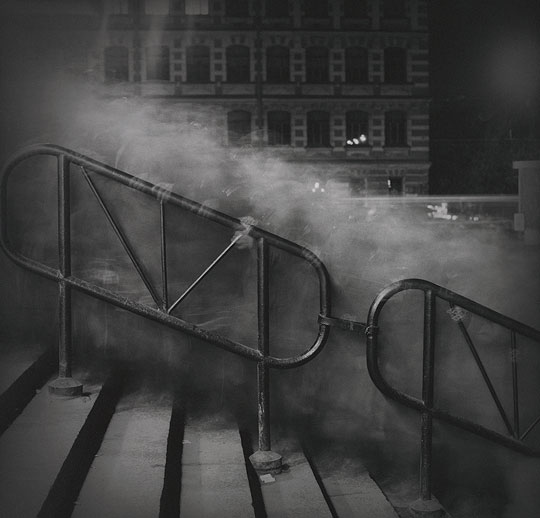
Alexey Titarenko. His series “
City of Shadows” captivated me. It is certainly not what one would call classic street photography; in fact, the book often skirts the boundary of the classic, even quoting the famous line “reality can only be explained through fiction,” which I first heard from my most important influence, Krzysztof Kieślowski.
Although iPhoneography might seem to be about a group of addicted fans and technobuffs who cannot stop using their
mobile phone, it is in reality the continuation of a trend that began with the advent of the Kodak Brownie in February
1900 and has been developing since then.
The Kodak Brownie is recognised as the beginning of photography for the masses and with it was born the term “snapshot”:
a photograph taken quickly without thinking, without any artistic or documentary intent, usually blurry, badly framed
and in which the subject is usually a scene from everyday life, such as birthdays, sunsets, pets or travel.
Passengers is a street photography project, in both web and book series form, about anonymous public transport
passengers. It’s designed as a participative online project. All the images are captured by mobile devices and published
on Instagram. The site is a “real-time view” of the participation process. The book is a visual meditation on public
transport passengers and the aesthetics of street photography using mobile devices.
I love books as a channel to teach photography. Exhibitions are fine, but they confine us to a specific space/time. The multimedia mix, which always ends up as a video, is interesting but forces the viewer into a rhythm, and although I find it very appealing, it hasn’t fully convinced me. That’s why, since we started the
Arrinconado project in
Barcelona Photobloggers, I’ve been researching and testing print‑on‑demand systems and now eBooks.
After much thought, this is the series I submitted to the London Street Photography Festival. I doubt it will win, there are many very good people in the world of street photography, but at least the selection process always serves as a system of self‑criticism and meditation on what we see when we shoot, on what “moves us” while we walk.
Project “Arrinconado” (Cornered) starts a new era for Barcelona Photobloggers. The objective was to create a
collaborative project with a horizontal organization in which all of the members would have an opportunity to
participate in every aspect of creation, from definition to production, and which would lead to a work authored by the
group and not by a gathering of various authors in the same space.
A black woman carries an Asian girl, both with umbrellas, crossing the anti‑terrorist protection barriers surrounding the building on Wall Street. Behind them a white man, dressed in business attire, asks for a hotdog. Another woman holds an umbrella with the American flag. In the background is Trinity Church, the founding entity of Columbia University, the first university in the state of New York. In its cemetery are buried some of the men who declared independence.
At the age of 6 I asked for a bicycle for my birthday. At 7 I got a camera, a Kodak Brownie Fiesta. Now I ride a motorcycle and carry a digital SLR. The dream of traveling hasn’t changed either. The curious thing is that I’ve been traveling with a camera all my life and I still haven’t fully understood the experience, neither emotionally nor photographically.
Of all the photos I took between ages 7 and 15 I clearly remember four: two of them from trips and two from the backyard. This game of rescuing images from memory after a long time is very interesting. I now use it to edit my series. After letting them sit for a few months I ask myself, “Lisbon?” The first photo that comes to mind is Lisbon, and I usually work from that point.
Synchronized to the urban rhythm it is difficult to question oneself. We are pulled like the current of a river whose destination we do not know. When suddenly we become a drop detached from the whole and fall vertically, feeling the vertigo of the cascade, we acquire a different awareness of our own nature.
Last summer we traveled to New York. I thought, “Summer! New York! Coney Island!” I had a photo of Bruce Gilden stuck in my head. But it couldn’t happen; there wasn’t a single day without rain… and we went back home, back to the routine. Within the repetitive, unglamorous activities, unlike past water travels, were the Barcelona Photobloggers activities, among them, giving a black‑and‑white lab course; tidying the house and asking myself what to do with expired black‑and‑white rolls; going to work, going to the beach…
“Unemployment keeps rising in Spain, punishing with the most cruelty small and medium-seize businesses. It is estimated that every day 500 independent contractors lose their jobs and every week about 4000 businesses are forced to close. The small and medium-size Catalan companies will demonstrate again tomorrow before the Congress…” (11-17-2009 “La Vanguardia” Newspaper. Barcelona. )
2000-2009 Book Self-published, 21×29 cm, 26 pages, laser color printing on recycled paper, manual binding. Edition: 10 books + 1 artist proof
Site-specific installation at Centre Civi Pati Llimona. 6x3m space with, various objects and photographs. 22 photographs (21 of A4 y one copy of 150x100cm), laser color printing on recycled paper, framed on cardboard. 200 photographs 10x15cm standard photo paper. Single copies.
 February 6, 2025